

Incremental Fock builds in quantum chemistry
How a Hartree–Fock solver can reuse the previous Fock matrix, where that reuse breaks down, and how to compare it with a full build.
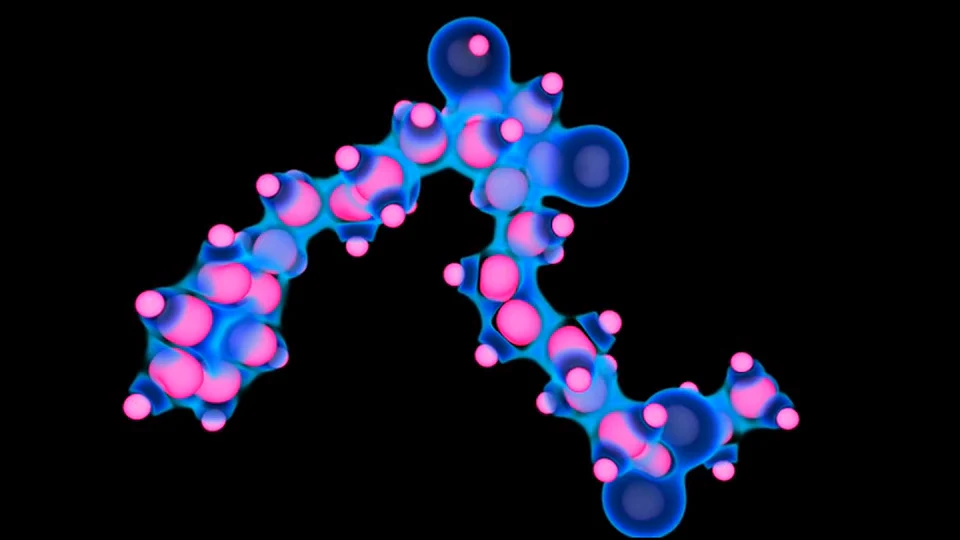
One molecule, many calculations
A flexible molecule can settle into many shapes. A conformer search changes the coordinates, evaluates the new geometry, and uses the resulting forces to pick the next move. The NASA Ames visualization shows latanoprost this way: the CREST workflow computes energy, charge density and atomic forces along the trajectory, and the colors mark where charge is concentrated or depleted as the molecule changes shape.
Inside each of those evaluations, many electronic structure calculations run a second loop. A Hartree–Fock solver starts from an estimate of the electron density, builds a Fock matrix from it, solves for new orbitals, and repeats until density and energy converge. Through that loop the nuclear coordinates and basis functions do not change. Almlöf, Faegri and Korsell described the direct form of this loop, which recomputes integrals on every iteration instead of storing them. Anything the iterations share is a candidate for reuse.
Build from the change in density
For a fixed basis and geometry, write the Fock matrix as F(P) = H + G(P). P is the density matrix, H is the fixed one-electron term, and G is the linear map that combines the Coulomb and exchange contributions. Because G is linear, G(P + ΔP) = G(P) + G(ΔP), so F(P + ΔP) = F(P) + G(ΔP). In exact arithmetic that is the matrix a full rebuild gives. Häser and Ahlrichs described this incremental form for direct SCF.
The saving depends on how ΔP looks. Suppose that late in a calculation the density changes mostly among a few pairs of basis functions. Contributions built from small changes fall below a chosen threshold and can be screened out, so the solver builds only the rest. The Q-Chem manual describes the same pattern: the number of integrals that need recomputing falls as the calculation converges, and incremental builds apply only to direct SCF. Psi4 documents density-based screening and an incremental Fock build option, INCFOCK, for some integral algorithms, and leaves it off by default. PySCF documents direct SCF with a cutoff threshold and uses direct SCF by default.
Each Fock matrix is now a running sum of increments, so screening and rounding errors can accumulate across iterations and change the path to convergence. Check the final solution against a full build.
What changes when the atoms move
Between two geometries in a conformer search, the atom-centered basis functions move. The one-electron term and the two-electron integrals move with them, so a density update alone cannot reconstruct the new Fock matrix. A previous density or set of orbitals can still seed a nearby calculation if the code can transfer it into the new basis. Measure that as a separate source of reuse.
Run the comparison at a fixed geometry
Start with the same molecule, basis, initial guess, convergence criteria and integral algorithm. Run the ordinary solver, then run it with incremental builds enabled. Record time in Coulomb and exchange construction, total time to convergence, and iteration count. Check the total energy and the final density, and compare forces if the workflow uses them. Repeat on easy and difficult geometries. A per-iteration gain counts only if the calculation still converges to the intended solution and the whole job finishes sooner.
Sources
- NASA Ames visualization of the latanoprost simulation
- Pracht, Bohle and Grimme on CREST conformer sampling
- Almlöf, Faegri and Korsell, Principles for a direct SCF approach to LCAO–MO ab initio calculations
- Häser and Ahlrichs, Improvements on the direct SCF method
- Psi4 documentation on Hartree–Fock integral screening and incremental Fock builds
- Q-Chem 6.3 manual on incremental and variable-threshold Fock matrix building
- PySCF API documentation for SCF, including direct SCF